Online Course · Udemy
Designing Production-Grade Deep Learning Pipelines
Take a deep learning model from a notebook to an automated, monitored production system on Google Cloud.
- Hours of On-Demand Video
- Downloadable Resources
- Articles
What You'll Build
One Pipeline, From Raw Data to a Live Endpoint
A complete, production-grade system that runs on your laptop and on Google Cloud, and retrains itself when new data arrives.
Evaluation-Gated Deployment
A new model ships only if it clears accuracy thresholds and beats the model already in production.
Event-Driven Retraining
New data in Cloud Storage triggers a fresh pipeline run automatically, with no manual retraining.
Same Pipeline, Laptop to Cloud
Build and debug locally with Apache Beam, then run the identical pipeline on Vertex AI.
What You'll Learn
Four Stages, From Notebook to Continuous Delivery
Every skill is applied to the same real system, so each stage builds directly on the last.
Build
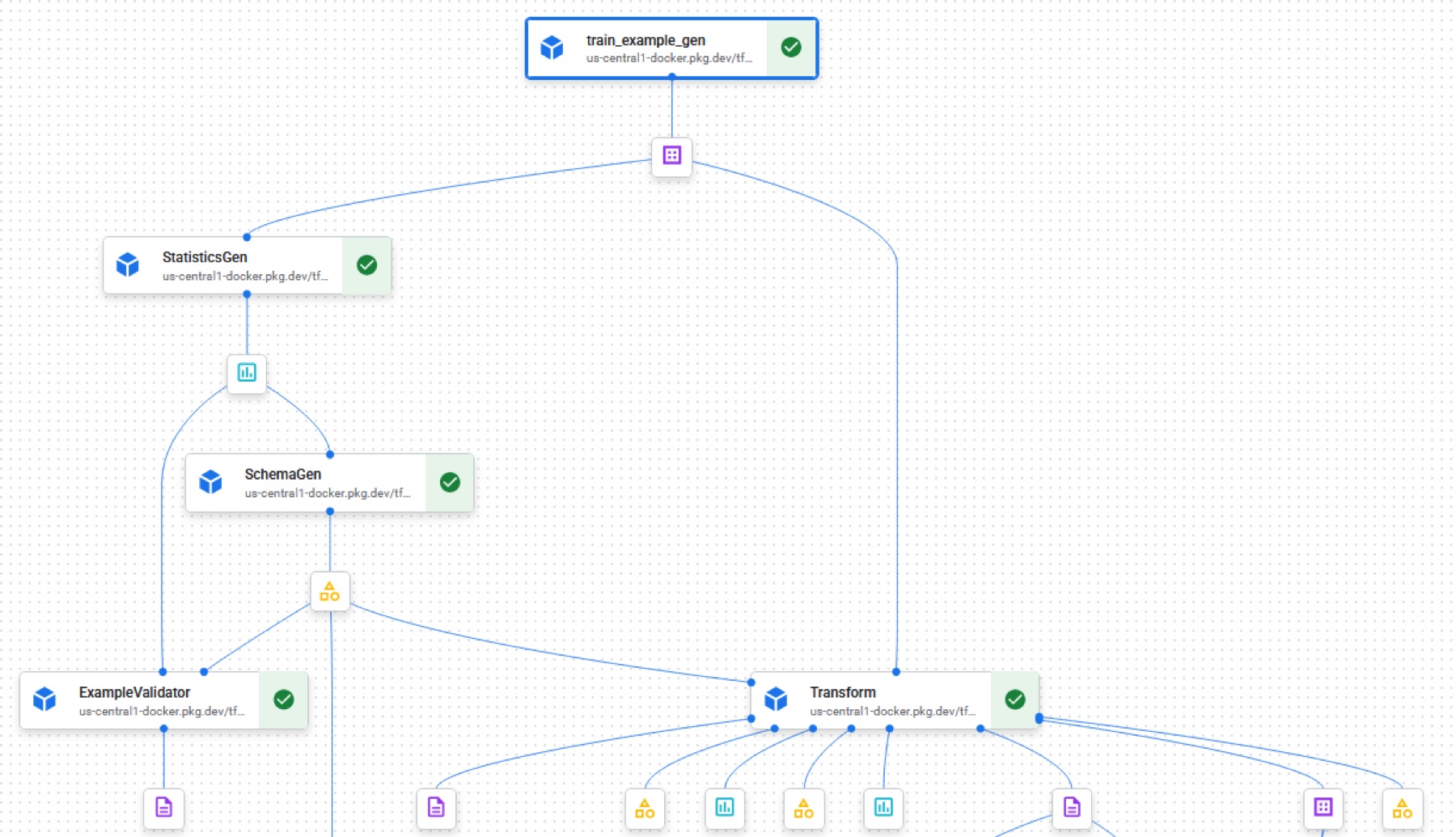
- Build an end-to-end TFX pipeline: ExampleGen, StatisticsGen, SchemaGen, ExampleValidator, Transform, Tuner, Trainer, Evaluator and Pusher
- Track experiments with MLflow and turn a Keras DNN from notebook code into a reproducible, versioned pipeline
TFX · Keras · MLflow
Orchestrate
- Run pipelines locally with Apache Beam, then run the same pipeline on Google Cloud Vertex AI Pipelines
- Containerize pipeline code with Docker and manage cloud access securely with IAM service accounts and Cloud Storage
Apache Beam · Vertex AI Pipelines · Docker · IAM
Deploy
- Register, version and serve models with the Vertex AI Model Registry and Vertex AI Endpoints
- Gate deployments with evaluation thresholds, so a new model ships only if it beats the current one
Model Registry · Endpoints · Evaluation Gates
Automate
- Trigger retraining automatically on new data with Cloud Run functions, and understand drift and training–serving skew
- Set up CI/CD for ML pipelines with GitHub Actions and keyless Workload Identity Federation
Cloud Run · GitHub Actions · Workload Identity Federation
The Course Journey
One Real Problem, Carried All the Way to Production
You predict the compressive strength of concrete from eight mix-design features, using the public UCI dataset, and take that model through four stages, each with its own folder in the companion code.
01_experimentation/Experiment
Explore the data, engineer features and design the Keras model in notebooks, tracking every run with MLflow.
02_local_pipeline/Run It Locally
Turn the notebooks into a TFX pipeline and run it end to end on your own machine with Apache Beam.
03_cloud_pipeline/Move to the Cloud
Containerize the pipeline, run it on Vertex AI Pipelines and serve the approved model from an endpoint.
04_cloud_run_functions/Automate It
Retrain automatically when new data arrives, and ship every change through CI/CD with GitHub Actions.
Who It's For
For People Who Can Train a Model, and Want to Ship One
This Course Is for You If…
- You can train a Keras or TensorFlow model, but haven't taken one to production yet
- You're an ML engineer or data scientist who wants reproducible, automated pipelines instead of one-off notebooks
- You want hands-on experience with TFX and Vertex AI on Google Cloud
What You'll Need
- Comfortable writing Python
- Basic Keras or TensorFlow
- A Google Cloud account. Cloud resources are billed while in use, and the course shows you how to clean up
No prior MLOps or Google Cloud experience required. Every service is introduced as you need it.
Companion Code
Every Line of the Course, Open Source
The full pipeline lives in a public GitHub repository, organized stage by stage so you can follow along, or jump straight to the part you need.
- Open source under the MIT license: reuse it in your own projects
- A pinned environment and data-prep script, so it runs the same on every machine
- Setup guides and lab notes for every stage
The Deployment GateA new model deploys only if its error stays under 10 MPa (MAE) and 15 MPa (RMSE), and it beats the model already serving.
View on GitHubgithub.com/real-ahmed-moussa/pdlp
pdlp/
├── 01_experimentation/# notebooks + module.py
├── 02_local_pipeline/# local TFX run · SQLite metadata
├── 03_cloud_pipeline/# Vertex AI · Docker · CI/CD
├── 04_cloud_run_functions/# retraining & deployment triggers
├── docs/# setup guides & lab notes
├── prepare_data.py# builds the data folders
└── requirements.txt# pinned environment
Start Building
Take Your Next Model All the Way to Production
Eight hours, one real problem, and a pipeline that validates, trains, evaluates, deploys and retrains itself on Google Cloud.
Let's Build Something That Matters
If you have a decision that depends on predicting risk in a complex system, I'd like to hear about it.